Buying guides
How to size a gasoline generator: running watts, starting watts and 50/60 Hz
By the Arbora export team. Published . 6 min read.
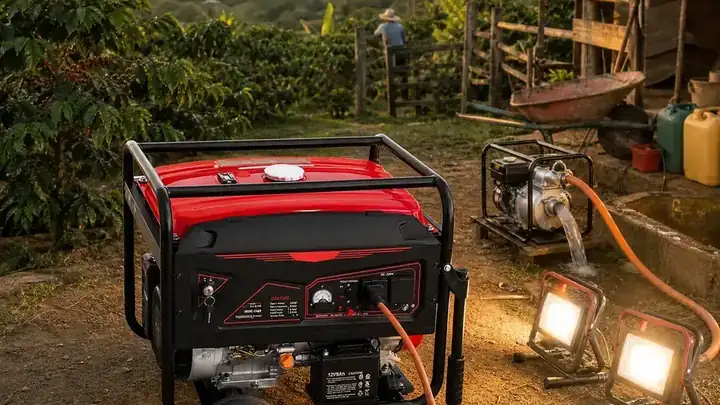
What is the difference between rated and maximum output?
Rated output is what the generator can supply continuously. Maximum output is a short peak used for motor starting. A generator listed as 5.5 kW rated and 6.0 kW maximum should be sized on the 5.5 kW figure.
How do I calculate the load?
- List every device that will run at the same time.
- Note its running watts (from the label).
- For motors (fridges, pumps, compressors, air conditioners) find the starting watts, often two to three times the running watts.
- Add all running watts, plus the single largest starting surge.
Worked example: a small shop
| Load | Running W | Starting W |
|---|---|---|
| Lights | 400 | – |
| Freezer | 300 | 900 |
| POS and router | 150 | – |
| Fan × 2 | 150 | – |
| Total | 1,000 | +600 surge |
The peak is about 1,600 W, so a generator with at least 2 kW rated output gives comfortable headroom.
Which generator size fits which job?
- 0.8–1.2 kW: lights, phone charging, small appliances.
- 3–3.5 kW: home essentials, small shop, power tools.
- 5.5–6.5 kW: whole-house backup, a site with several tools.
- 7–8 kW and silent diesel: continuous commercial backup, ATS installations.
Why do 50 Hz and 60 Hz matter?
Frequency must match your grid. Most of Europe, Africa, Asia and Australia use 50 Hz; North America, much of Latin America and parts of Asia use 60 Hz. Engine speed and alternator are set at the factory, so state the frequency on your purchase order.
Copper or aluminium windings?
Copper windings run cooler and tolerate overloads better; aluminium windings cost less. Several of our generators are offered in both, so you can price for different channels.
Next step
Send us your target load, voltage, frequency and socket standard and we will recommend a model and quote with the correct panel.
Related products
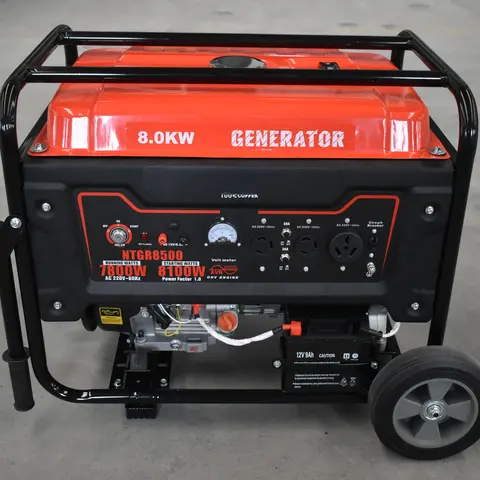
NTGR8500 Gasoline Generator – 8 kW, Electric Start
8 kW, 4-stroke
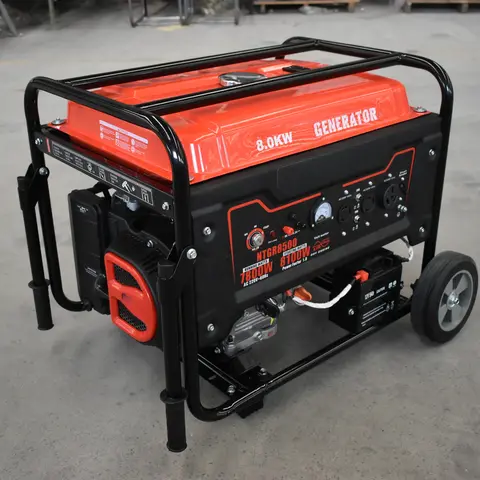
NTGR8500 Gasoline Generator – 8 kW, Heavy Duty
8 kW, 4-stroke
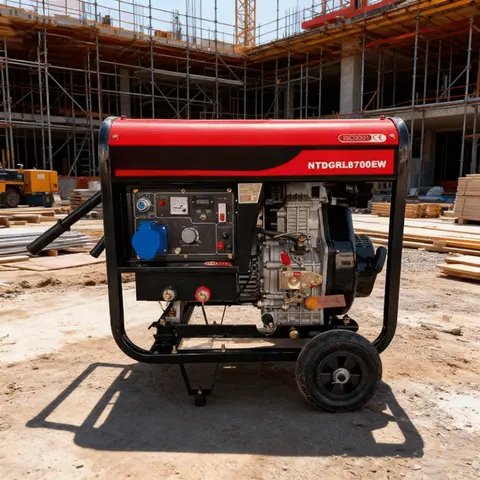
NTDGR6700EW Diesel Welder Generator – 5.5 kW, Silent
5.5 kW, 4-stroke
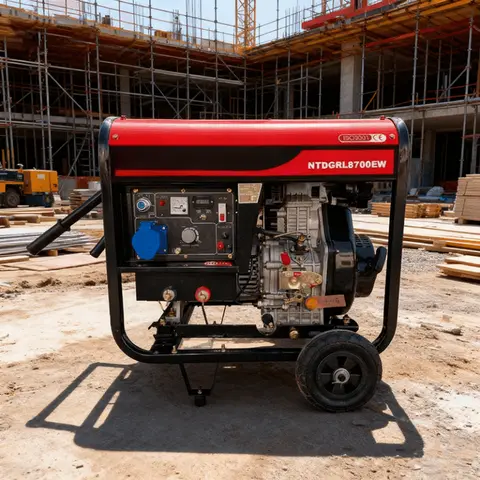
NTDGR6700EW Diesel Welder Generator – 5 kW, ATS
5 kW, diesel
Ask our team
Questions about this guide or a quotation. We reply within one working day.